Major Chords Theory
Major chords are the most common type of chord.
| Character of a major chord
They create a bright, "happy" sound. They possess a feeling of resolution and finality. (These chords are often used after more unstable chords such as the dominant sevenths or suspended forths)
Major Chord Notated
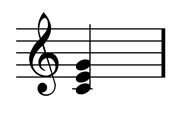
Usually a major chord is notated by a capital letter, with no additional letters. E.g. C major chord on a chord sheet is simply "C". Occasionally people write "Cmaj", although this is not strictly necessary.
|
C major chord notated
|
Major Chord Theory - how to work out any major chord.
The major chord is composed of the root note (tonic) of the scale, the third (mediant),and the fifth note (dominant).
So if you play the scale of C, hold the first note of the scale down (C), the third note (E) and the fifth (G), and this will give you C major chord.
|
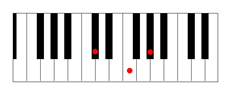
C# major chord
|
This technique is fine if you know all your scales! But most people don't, so here is another way of approaching this:-
Say you need to figure out C# major, a more unusual chord.
The first note, obviously, is the C# key (one up from C)
For the second note, count 4 notes up from C#
(counting all the black and white keys, but do not include the first key). This should land you at the note F. From here, count a further 3 keys (again, do not include the "F" key). You should now be on G#.
This gives you the three notes C# - F - G#.
|
So in summary, all major chords are formed from the pattern of 4 steps then 3 steps.
MAJOR - 4 - 3
TOP TIP: To remember this pattern, you might like to think of inviting an Army Major for three O'Clock. MAJOR 4 3 !
This works for any major chord. In music theory terms, what you are in fact doing is counting 4 semitones (a semitone is the smallest step you can go on a musical scale), then 3 semitones.
| A common misunderstanding
Major chords are all white key chords.
Whilst this holds true for the major chords you are likely to learn as a beginner (C, F and G), it's not going to be long before you run into black keys! (e.g. D major has an F#)
|
|
|